Predictive Analytics: Turning Data Into Business Foresight
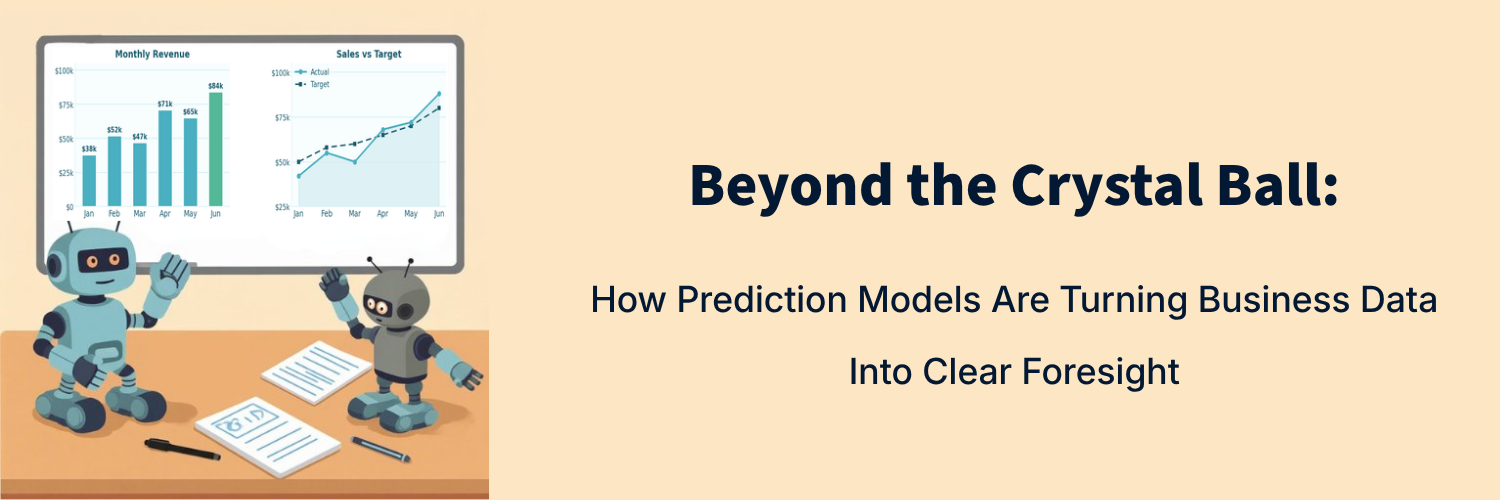
In the traditional business landscape, strategy was often a game of rearview mirror management. Leaders relied on end-of-quarter reports and historical spreadsheets to understand performance, which meant that by the time a problem was identified, the window for an easy fix had already closed. Organizations were constantly playing catch-up.
Today, that paradigm is shifting. The modern enterprise is shifting from reactive decision-making to a proactive approach, driven by the maturity of prediction models.
What Actually Drives Prediction?
At its core, a prediction model is a mathematical framework that analyzes large amounts of historical and real-time data to forecast future outcomes. Rather than providing simple projections, predictive models uncover underlying trends and detect early warning signs that would be invisible to the human eye.
When these models are integrated into daily operations, they transform data from a passive record of what has already happened into an active tool for planning what will happen next.
The Essential Components of Predictive Modeling
Different business challenges demand various analytical methods. Enterprise leaders should recognize that Predictive modeling is not a single tool but a versatile toolkit, with each technique serving a specific purpose.
- Time Series Forecasting: This is the foundation for any business driven by cycles. Whether you're managing seasonal retail demand, forecasting revenue trends, or optimizing workforce capacity, time series models analyze historical data to predict future outcomes.
- Regression-Based Prediction: When you need an exact number, you use regression. These models analyze relationships among variables to estimate continuous outcomes, such as the precise cost of a new project, the best price for a service, or projected energy use.
- Classification-Based Prediction: Sometimes, the goal is to categorize outcomes rather than compute a number. Classification models drive fraud detection and churn prediction by identifying risky customers or transactions that differ from normal patterns.
Beyond Simple Trends: The Advanced Predictive Capabilities
While standard forecasting is useful, genuine business resilience arises from advanced intelligence that considers nuance and uncertainty.
- Probabilistic Prediction: Real-world outcomes rarely follow a straight line. Bayesian models and Monte Carlo simulations help leaders evaluate the likelihood of different scenarios, allowing them to consider a range of possible outcomes rather than a misleading single estimate.
- Anomaly Detection: Systems like Isolation Forests are designed to identify anomalies. In fields such as cybersecurity and predictive maintenance, these models detect small deviations from the norm before they escalate into full-scale system failures or security breaches.
- Recommender Systems: By predicting individual preferences through sophisticated filtering, businesses can personalize experiences at scale, making sure the right products or services match the right customer exactly when needed.
The Business Case for Seeing What's Coming
The conversation about prediction technology often becomes abstract quickly. Discussing algorithms and model accuracy can start to seem disconnected from the real challenges of running a business. The business impact of predictive modeling is both measurable and significant.
- ↓ 23% - Average inventory overstock reduction through demand forecasting
- 3x - Faster response to anomalies vs. rule-based monitoring systems
- ↑ 40% - Improvement in churn prediction accuracy over manual segmentation
The Bottomline
The true value of predictive models lies not only in forecasting outcomes, but in explaining the drivers behind them. When an enterprise can anticipate a change and understand the drivers behind it, it can act decisively.
Whether it is adjusting a supply chain before a logistics bottleneck occurs or offering a retention incentive before a customer churns, predictive foresight bridges the gap between seeing a problem and solving it. It converts future uncertainty into a manageable strategic roadmap, ensuring that enterprise leaders spend less time reacting to crises and more time steering their organizations toward sustained growth.
To explore how predictive intelligence can transform your business, reach out to our team at www.kdapt.com or email us at info@kdapt.com. To see these models in action and learn what KDAPT can do for your business, schedule your personalized demo here.